Ingredients List Order and Additives Explained
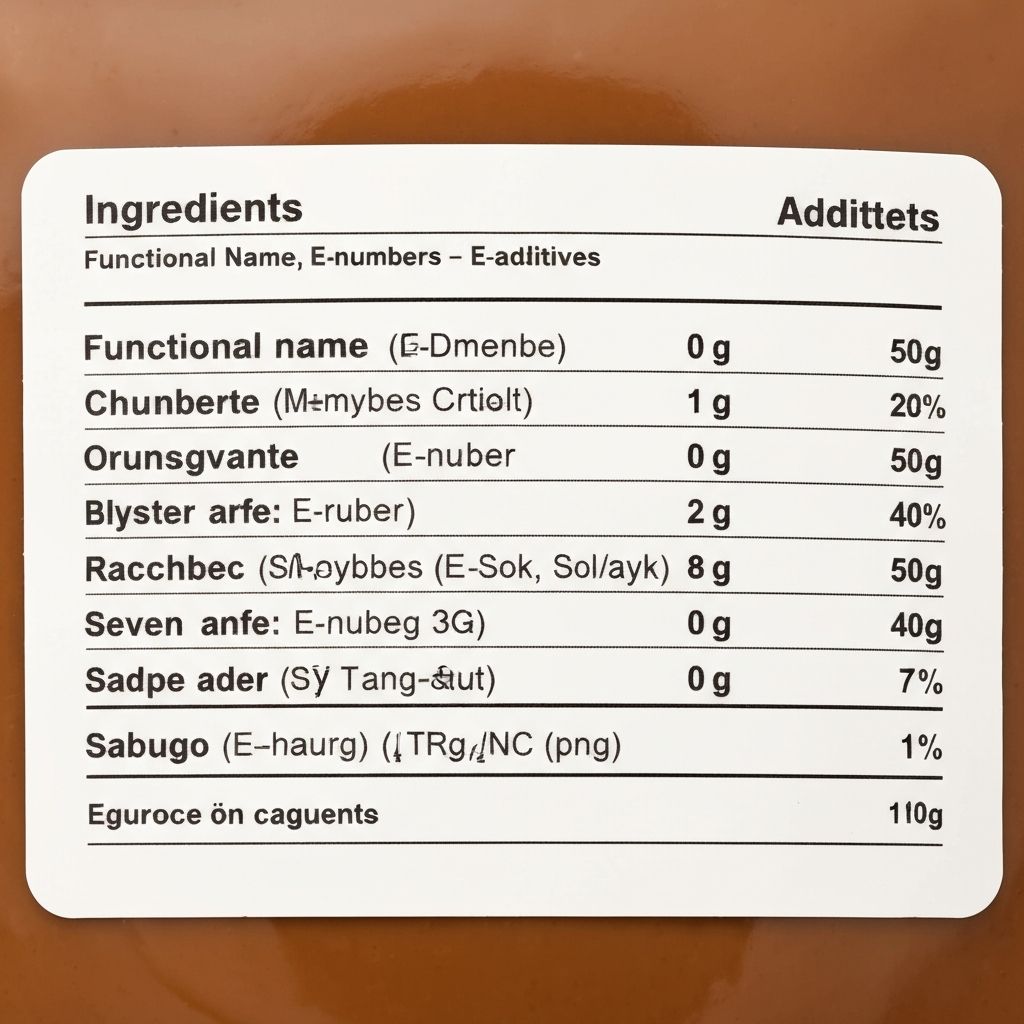
The ingredients list on food packaging provides valuable information about what components are in the product. Understanding how to read this list is an important skill for understanding the composition of packaged foods.
Ingredients Listed in Descending Weight Order
All ingredients must be listed in descending order of weight. This means the ingredient present in the largest quantity appears first, and the ingredient present in the smallest quantity appears last.
For example, a breakfast cereal might list "whole grain wheat" first, followed by "sugar," then "water," then various additives. This order tells you that the cereal contains more wheat than sugar, and more sugar than water.
This ordering system allows consumers to quickly identify the main components of a product without reading the entire list.
Understanding E-Numbers and Additives
Additives are substances added to food for specific functional purposes, such as preserving freshness, improving texture, or enhancing flavour. All additives used in UK food must be approved and listed on packaging.
Additives can be identified in two ways:
E-Number System
The E-number system uses codes such as E330 (citric acid), E202 (potassium sorbate), or E471 (mono- and diglycerides). The letter "E" stands for "Europe," indicating approval by the European Union (which the UK has largely adopted).
Functional Names
Alternatively, additives can be identified by their functional name plus the specific name. For example, "preservative: sodium benzoate" or "emulsifier: soya lecithin." This approach provides more descriptive information than an E-number alone.
Categories of Additives
Different additives serve different purposes in food:
- Preservatives: Extend shelf life by preventing spoilage (e.g., E200–E299 range).
- Colourings: Add or restore colour to food (e.g., E100–E180 range).
- Emulsifiers and Stabilisers: Help maintain texture and consistency (e.g., E400–E500 range).
- Flavour Enhancers: Intensify taste (e.g., E600–E699 range).
- Sweeteners: Provide sweetness with less or no sugar (e.g., E950–E969 range).
- Antioxidants: Prevent oxidation and rancidity (e.g., E300–E321 range).
- Acidity Regulators: Adjust or maintain acidity (e.g., E330–E385 range).
Compound Ingredients
When a product contains a compound ingredient (an ingredient that is itself made from other ingredients), that compound may be identified by name followed by its own sub-list of ingredients in brackets.
For example, a cake mix might list "chocolate chips (sugar, cocoa butter, cocoa mass, emulsifier: soya lecithin, vanilla extract)" as a single ingredient entry. The ingredients within the brackets are the components of the chocolate chips.
Recognising Common Ingredient Patterns
The length and complexity of an ingredients list can provide information about the degree of processing:
- Simple products typically have short ingredients lists with recognisable names (e.g., "whole grain oats, salt").
- More processed products typically have longer lists that include multiple additives and ingredients with technical names.
- The presence of many E-numbers may indicate a product has undergone significant processing.
Allergens in Ingredient Lists
The 14 major allergens must be emphasised in the ingredients list through bolding, italics, or colour. Common allergens that may appear in ingredient lists include milk, eggs, nuts, sesame, soya, gluten-containing cereals, and others.