Legal Definitions of Common Marketing Terms
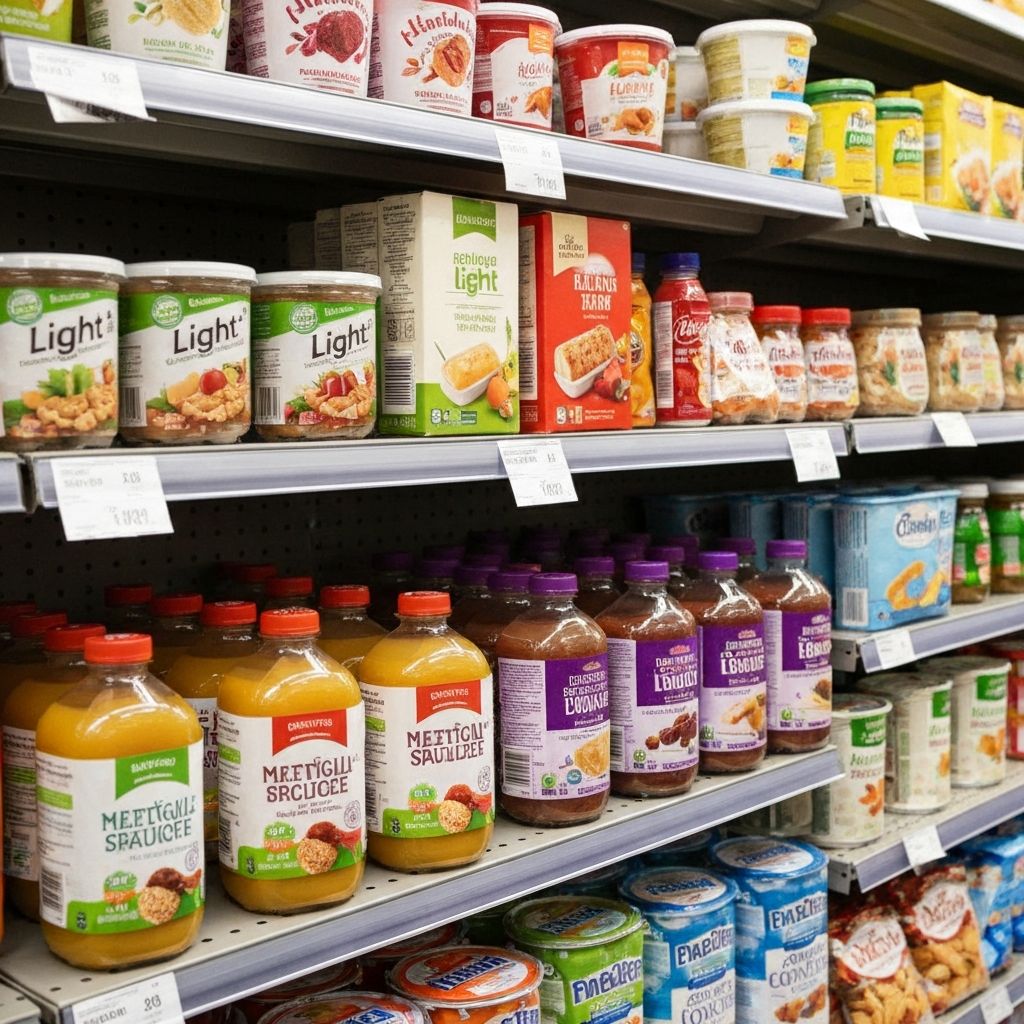
Food packaging often displays marketing terms such as "natural," "light," "reduced," and "source of." Understanding the legal definitions of these terms helps consumers interpret them accurately.
Natural
The term "natural" has no standardised legal definition in UK food labelling. Unlike other marketing terms, "natural" is not strictly regulated by specific legislation.
This means manufacturers have considerable flexibility in using this term. A product might be labelled "natural" even if it contains additives or has undergone significant processing.
The term is best understood as a marketing descriptor rather than a regulated nutritional claim with specific meaning.
Light or Lite
"Light" or "lite" claims are regulated. To use these terms, a product must contain at least 30% less of a specific nutrient compared to a standard version of the same product or a similar product.
For example, "light olive oil" might indicate lower fat content than standard olive oil, but the specific nutrient claim must be declared on the packaging.
The manufacturer must clearly state which nutrient has been reduced (fat, salt, sugar, calories, etc.).
Low-Fat
A product can use the "low-fat" claim if it contains no more than 3g of fat per 100g of solid food, or no more than 1.5g of fat per 100ml of liquid food.
This definition provides a specific threshold. If a product exceeds these limits, it cannot legally use the "low-fat" designation.
Reduced
"Reduced" claims indicate that a specific nutrient has been reduced by at least 25% compared to the original product formula.
For example, "reduced salt" means the product contains at least 25% less salt than the same product without the reduction. The manufacturer must declare the specific nutrient that has been reduced.
Source Of
A product claiming to be a "source of" a specific nutrient must contain at least 12% of the Reference Intake (RI) per 100g of that nutrient.
For example, "source of fibre" means the product provides at least 12% of the daily recommended intake of fibre per 100g.
Common "source of" claims include "source of protein," "source of vitamins," and "source of minerals."
High In
"High in" claims require at least 20% of the Reference Intake per 100g.
This represents a stronger claim than "source of." For example, "high in vitamin C" means the product provides at least 20% of the daily recommended intake of vitamin C per 100g.
Other Common Claims
No Added Sugar
This claim indicates no sugar or sugar-containing ingredients were added during manufacture. However, the product may still contain naturally occurring sugars.
Sugar-Free
A product is sugar-free if it contains less than 0.5g of sugar per 100g or 100ml.
Salt-Free
Salt-free products contain less than 0.12g of sodium per 100g or 100ml.
Fortified or Enriched
These terms indicate that nutrients have been added to the product. "Enriched" typically refers to replacing nutrients lost during processing, while "fortified" refers to adding nutrients.
Important Context
These marketing terms describe individual nutrients or characteristics, not overall nutritional value. A product can be "low-fat" and still be high in sugar, for example.
Marketing claims should be evaluated alongside the complete nutrition information panel on the back of the packaging for a fuller understanding of the product's nutritional profile.